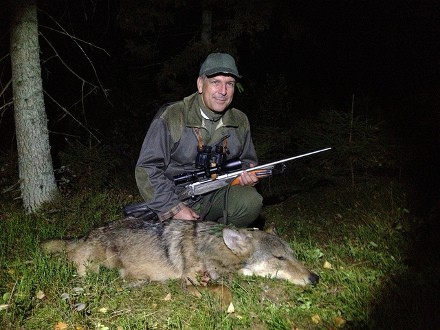
Wolf Hunting in Estonia
Wolf hunting is permitted from November 1st to February 28th. Wolf can be hunted from stands over bait sites or in driven hunts.
The volume of wolf hunting varies by year; however, in recent years wolf hunting quotas have increased to mitigate the damage caused by their presence. The Rakvere district presents the greatest opportunities for wolf hunting.
The Wolf in Estonia
Currently there are more than 1,000 wolves in Estonia and their population remains very stable with multiple food sources, mainly thanks to the high density of wild boar we have in Estonia.
Wolf Hunting from Stands
Wolf hunting from stands is done mainly in January and the first part of December, which is when wolves visit bait sites most frequently.
The success of this hunt depends mainly on the wolves' habits as well as the hunter's ability to endure long waits in low temperatures.
How the Hunt Works
Wolf hunting from stands is done exclusively from high seats located over meat bait sites.
The hunter must remain on the high seat from 5 PM until late at night and must always remain vigilant since sometimes the wolf gives no more than a few seconds, making the opportunity quite quick.
Characteristics of Wolf Hunting from Stands
The wolf is an animal with great instincts and intelligence and is normally a very reluctant animal to visit bait sites, although at the beginning of winter it tends to lower its guard and visits bait sites more frequently since it needs a greater protein intake.
Since we have trail cameras at the bait sites, we know at all times the habits of the wolves, so the hunter will be informed at all times of the situation.
In recent years we have had a very high success rate, close to 90%.
Wolf Hunting in Driven Hunts
Wolf hunting in driven hunts is done from early November until the end of February. This hunting method is very effective and in each drive, normally between 3 and 6 specimens are harvested.
This method is perfect for large groups who want to combine wild boar hunting with wolf hunting in driven hunts. Similar to wild boar driven hunts in Estonia, this hunt requires coordination and teamwork.
How the Hunt Works
Wolf hunting in driven hunts begins at dawn when our guides traverse the hunting areas looking for fresh wolf tracks. Once a track is located, it is verified that the wolves are situated in an area easily manageable by a group of 15-25 hunters.
As soon as the guides inform us of the situation, we proceed to surround the area with flags tied to a rope that will be placed along the entire perimeter of the thicket, then proceed to position the hunters at the points where there is more probability of having a good opportunity.
When all hunters are positioned, our guides will enter the thicket firing shots in the air with blank cartridges to make the wolves move and try to leave the thicket.
The preparation of the hunt normally lasts between 3 and 4 hours while the hunt itself normally lasts less than 1 hour during which the hunter must remain very attentive to wolf movements and shoot only at wolves, thus ensuring the wolves do not perceive the hunter's presence.
Characteristics of Wolf Hunting in Driven Hunts
Wolf hunting in driven hunts is highly effective, although it is only offered to wild boar groups as an alternative species. The reason is that it is very complicated to guarantee the organization of the drive since good weather conditions are necessary, as well as the luck factor of being able to find tracks in a manageable area, which is quite complicated in many cases.
In case the hunter wants to come exclusively to hunt wolf, they should opt to hunt wolf from high seats over wolf bait sites.
Information about the Wolf (Canis lupus)
Canis lupus lupus, or Eurasian wolf, is the most well-known wolf subspecies. A carnivorous mammal, it belongs to the canid family, an excellent hunter with a dog-like appearance.
Physical Description
Its long, sharp canines adapted for hunting are very characteristic. They are strong and fast animals (they can reach up to 65 km/h). The eyes are oblique and golden, the neck strong, the tail long. They have a double coat, waterproof and protecting them from the cold, although in summer they shed their coat and have a lighter appearance. The hind legs are longer than the front ones, allowing them to make jumps up to 5 meters. They have special membranes between their toes that facilitate movement on snow. The coat on the tail, back, and neck is normally darker than that on the rest of the body. They have a height between 60 and 90 cm. Their length can be up to 2 m. They can weigh between 40 and 70 kg.
Distribution and Habitat
The Eurasian wolf is currently the most widely distributed wolf subspecies in the world. Present in Europe and Asia: Scandinavia, Estonia, Latvia, Lithuania, China, Mongolia, Russia, and the Himalayas. They are territorial animals, living in packs that constantly move in search of prey. Their territories normally reach 200 square kilometers, although they establish an area of about 40 square kilometers where they spend most of their time. It should be noted that the territory dominated by wolf packs always depends on the abundance or scarcity of food they find.
Diet
They generally feed on ungulates, normally hunting in packs, generally sick or injured animals. For this they rely exclusively on their jaw, since unlike other predators they do not have claws. They are capable of bringing down adult moose and bison. They can also feed on carrion and even add plants to their diet.
Reproduction
As a general rule, only the dominant pair can reproduce, which causes young wolves to leave their birth packs in search of new territories. The female's mating period lasts between 5 and 15 days, which can occur between February and April. Gestation lasts between 60 and 65 days and litters are normally 4-7 pups.