Roe Deer Hunting in Estonia
Roe deer hunting in Estonia is mainly done through stalking in open fields as well as from stands over bait sites prepared specifically for roe deer. Roe deer can be hunted from June 1st to October 30th.
Roe Deer in Estonia
Roe deer have lived in Estonian territory for about 10,000 years. Today the roe deer density is recovering after the very high mortality of this species in recent years, as winters have been very cold and long, and we have also had a lot of snow which makes their feeding very complicated.
Roe Deer Stalking
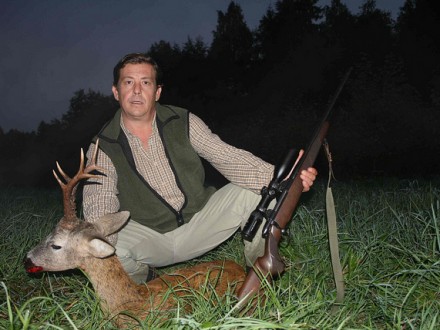
Roe deer stalking is normally done in summer in the fields, although hunting of this species is permitted until the end of December. This is a very interesting hunt since it requires the hunter to demonstrate great skills to approach the roe deer silently while maintaining composure to make a precise shot.
This hunt is perfect to combine with wild boar hunting by stalking since it takes place on the same dates and reserves.
How the Hunt Works
Roe deer stalking is mainly done in summer when we have almost 20 hours of daylight. Two outings are made per day, one in the morning and one in the afternoon.
The first outing starts at 4 AM when we traverse the fields using one of the off-road vehicles and are always accompanied by one of our guides. As soon as a good roe deer specimen is located, we will proceed to make a silent stalk taking into account the wind as well as ensuring a shot with guarantees is possible. This morning hunt normally lasts between 4 and 5 hours.
The second part of the hunt takes place in the afternoon, leaving the accommodation at 6 PM, and the procedure is the same as the morning outing.
During this hunt, it is very likely to find wild boar in the same fields, which is why combining the two species is recommended.
Characteristics of Roe Deer Stalking
This hunting method is normally very productive and excellent roe deer specimens are normally hunted. There are normally 2 or 3 opportunities per day of harvestable specimens.
It is recommended to bring good binoculars and a scope with high magnification since shots up to 150 meters are not uncommon. Regarding caliber, we recommend a caliber with a very flat trajectory and since roe deer hunting is combined with wild boar hunting, it is also recommended to bring different types of bullets depending on the species to be harvested.
Information about Roe Deer (Capreolus capreolus)
Belonging to the deer family, its species is called Capreolus capreolus. It is the smallest cervid in Eurasia. There are many local subspecies of roe deer. It differs from most European cervids by being a solitary animal, especially males, who during the mating season are very territorial and their domains normally reach 7 hectares. They reach sexual maturity when they reach one year of age and normally live around 12 years.
Physical Description
The adult roe deer normally reaches a height of 75 cm and a length of 1.30 m. Its weight oscillates between 20 and 25 kg, although sometimes specimens exceeding 25 kg are found. Its tail is quite small, measuring about 2 cm. Males have antlers that are not very large, which as a general rule have 3 points. These antlers are shed every year at the beginning of winter and finish developing at the beginning of spring, around May. Roe deer antlers grow every year and reach around 25 cm when the animal turns 4 or 5 years old. Both males and females have a reddish coat during summer, which changes to grayish during winter. The young have a reddish coat covered with lighter spots, which facilitates camouflage.
Distribution and Habitat
Roe deer are distributed throughout Europe except for the Mediterranean islands and Ireland; they are also found in western Russia. In addition to Europe, they can be found in Syria, Iraq, Iran, Turkey, and the Caucasus. Roe deer are animals with a great capacity for adaptation. This allows them to live in large meadows, dense forests, dehesa areas, and can even adapt to modern agricultural areas.
Diet
They are browsers of shrubs and low trees. They feed on various types of grasses, cereals, tree and shrub shoots, and berries.
Reproduction
The mating season begins around July and lasts all summer. Males, who become particularly territorial during this period, cover several females who will delay gestation for 5 months. After 5 months from mating, gestation will occur, which will last another 5 months, and the birth will arrive at the end of spring, from which normally one or two fawns are born who will live with the mother until the following spring.