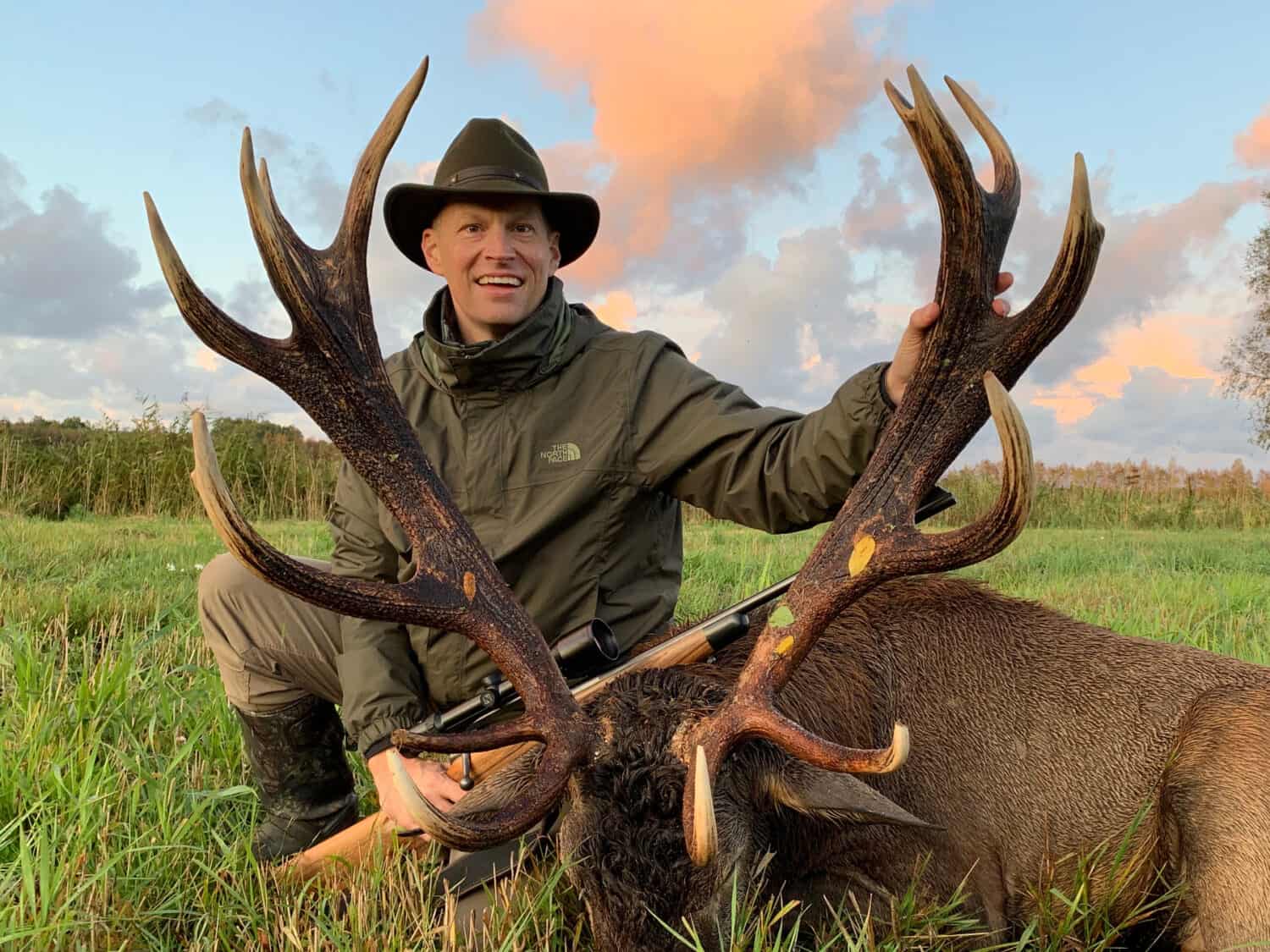
Red Deer Hunting in Estonia
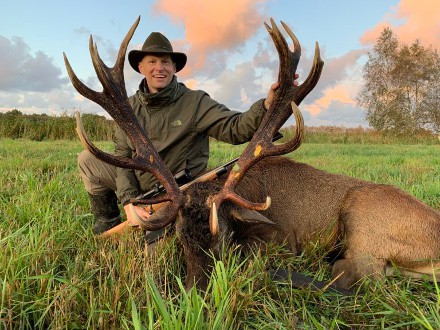
Red Deer is hunted by calling during the rut at the end of September. In Red Deer hunting, we guarantee the harvest of a medal-class trophy.
Red Deer hunting must be booked before August since the number of licenses is very limited. Our organization exclusively organizes Red Deer hunting for medal-class trophies.
Red Deer in Estonia
Estonia has what are probably the largest Red Deer in Europe and they are found mainly on the Islands of Hiiumaa and Saaremaa where we have specific hunting areas for Red Deer hunting. The densities and quality of Red Deer on the Islands are, by far, the highest in Estonia, surpassing in popularity European moose hunting.
Red Deer Hunting During the Rut
Red Deer hunting during the rut is considered the quintessential deer hunt and we offer a 100% success guarantee in hunting medal-class deer.
Hunting is done exclusively on the Islands of Saaremaa and Hiiumaa where the largest and highest quality Red Deer populations in Estonia are found.
Red Deer were introduced to Estonia by the Germans after World War I and they chose the Islands to prevent their spread to the rest of the country and avoid the possible impact this introduced species could have on other species, such as the European Moose.
Estonia's Red Deer are considered the largest wild deer in Europe and every year we harvest no fewer than 3 gold medal trophies.
How the Hunt Works
Red Deer hunting during the rut begins at dawn. Accompanied by a local guide, the hunter will traverse the reserve paying attention to the roars of the deer and looking for the best specimens.
Once the specimen that matches the desired characteristics is found, the stalk will proceed taking into account the wind and always trying to have a good shooting angle.
The same process is repeated two hours before sunset.
The hunt normally lasts between 4 and 5 hours and requires the hunter to be able to walk several kilometers per day.
Characteristics of Red Deer Hunting During the Rut
During the rut, the Red Deer is much less cautious and its hunting does not present great difficulties although it may be necessary to walk great distances.
Shooting is normally done at average distances of 100 meters and it is recommended to bring a high caliber with a flat trajectory.
Information about Red Deer (Cervus Elaphus)
Cervus elaphus, also called common deer, noble deer, or red deer, belongs to the deer family and is an artiodactyl, which means they have an even number of hooves. They are ruminants and excellent swimmers. It is a gregarious animal that usually forms herds where the alpha animal is a female; males are more solitary. It is one of the 100 most harmful invasive exotic species in the world.
Physical Description
They can measure up to 2.5 m in length and 1.5 m in height. Adult males can weigh about 250 kg and females about 110 kg. They normally live between 15 and 20 years. Their body is well adapted to rough terrain; their legs are very strong and long. A long, thin neck contrasts with the size of the head, which is enormous. They have excellent hearing thanks to large ears. Males have antlers made of dead bone with several points, normally about 10 although there are some with antlers of more than 20 points. The antlers are shed every year, during autumn, growing larger each time they are shed. The male with the largest antlers will be dominant. The coat of this deer is reddish, although somewhat lighter on the belly and rear. In winter they change from reddish to a more grayish tone.
Distribution and Habitat
Red deer are distributed throughout the Northern Hemisphere although it is easy to find them especially in Europe and Asia. They normally inhabit deciduous and mixed forests and although they spend a lot of time moving in search of food, they tend to establish an area of several kilometers where they live. They also adapt to large plains that offer them enough food to survive.
Diet
They are herbivores, feeding mainly on tree leaves, acorns, grass, legumes and grasses, moss and lichens.
Reproduction
Females reach sexual maturity between 2 and 3 years of age, males at 3 years although males do not mate until they are sufficiently developed to defeat other males and earn the right to cover some females, which normally occurs when they are between 6 and 8 years old. The rut begins at the end of summer, between September and October. During this period, males, who spend the rest of the year alone or in small groups of no more than 5 or 6 specimens, approach females and fight each other so that the strongest earns the right to procreate. During the rut, males lose a lot of weight and strength due to the hard fights and because they do not eat. Once the dominant male has covered the females in his harem, he will withdraw in search of food to recover. Gestation lasts about 8 months and births are of a single calf that will be nursed by the hind for 3 months.